
Clarify your HR career direction.
Talent helps HR professionals build a private career profile: direction, strengths, preferences, and the way they want to be understood.
Six sessions · about 20 minutes each
Target roles and locations
What am I aiming for next, and where would I take it?
Value proposition
What am I trusted with, and what changes because I was there?
Direction
What move am I making, and why is it a step rather than a sidestep?
Evidence
Which four or five situations actually demonstrate this?
Fit criteria
What has to be true for a role to be worth my energy?
Constraints
What is simply true about where and how I can work?
Leave with words you can actually use.
Short coaching sessions that help you say what you are good at, where you are heading, and what a role has to offer before it is worth your time.
Not a job board, and not another profile to fill in. You finish each session with something written down that you can take into an application, an interview, or a conversation with a recruiter.
Your value proposition
What you are trusted with, and the value you create — in language you would actually say out loud.
Your direction
The move you are making and why it is a step forward, not a sideways one.
What has to be true
The conditions a role must meet before it is worth your energy. Used to read every opportunity you see.
Start here
What is actually in your way?
Careers in HR is four things, and which one matters depends entirely on where you are. Pick the sentence that sounds like your week.
“I cannot see what is actually out there.”
MarketEvery live Australian HR role in one view — employer-led, recruiter-led and public sources — instead of six tabs and three job boards.
Take me there“I apply, and hear nothing back.”
TalentUsually this is not effort, it is positioning. A twenty-minute session gets you two or three sentences about what you are trusted with that you can actually say out loud.
Take me there“I cannot tell if this role is worth the effort.”
ReadA ReadNote reads the job ad against your CV and your own positioning, and tells you where you are strong, where you stretch, and what nobody can know from the ad.
Take me there“I do not know what I want next.”
TalentStart with the roles you would actually take and where you would take them. It is the shortest path to a shortlist that looks like your career rather than the market average.
Take me there“I am not looking — I have just started something new.”
Tenure · freeKeep a private record of what this role is teaching you while you are still living it. Most people only think hard about their career after deciding to leave; the useful material is in the months before that.
Take me thereMost HR careers are explained badly, by the people living them.
Not for lack of substance. Describing your own value is genuinely hard, and a CV is the wrong tool for it — it records what you did, not what you are trusted with. These sessions are the practice you rarely get before it matters.
Say it before you are asked
Interviews ask what you are known for and where you are heading. Working that out under pressure is the hardest possible time to do it.
Decide what is worth applying for
Naming the conditions a role has to meet turns a long list of opportunities into a short one, and saves the energy you would spend on the wrong applications.
Keep it, and reuse it
The same few paragraphs serve an application, an interview answer, a recruiter call, and a profile. Written once, sharpened when your thinking moves.
What this is:
Four short coaching sessions that each produce one thing you can use — how you describe your value, where you are heading, the evidence behind it, and what a role has to offer before it is worth your time.
What this is not:
Not a job board, not a placement promise, not a profile that sits there being complete, and not a tool that writes your positioning for you.
How the workspace builds
From profile clarity to aligned opportunities.
The Talent experience works in layers: first clarify your profile and positioning, then use that signal to understand which opportunities are most relevant.
Six sessions · about 20 minutes each
Target roles and locations
What am I aiming for next, and where would I take it?
Value proposition
What am I trusted with, and what changes because I was there?
Direction
What move am I making, and why is it a step rather than a sidestep?
Evidence
Which four or five situations actually demonstrate this?
Fit criteria
What has to be true for a role to be worth my energy?
Constraints
What is simply true about where and how I can work?
What members build
- Build a stronger profile and positioning layer that carries across the ecosystem.
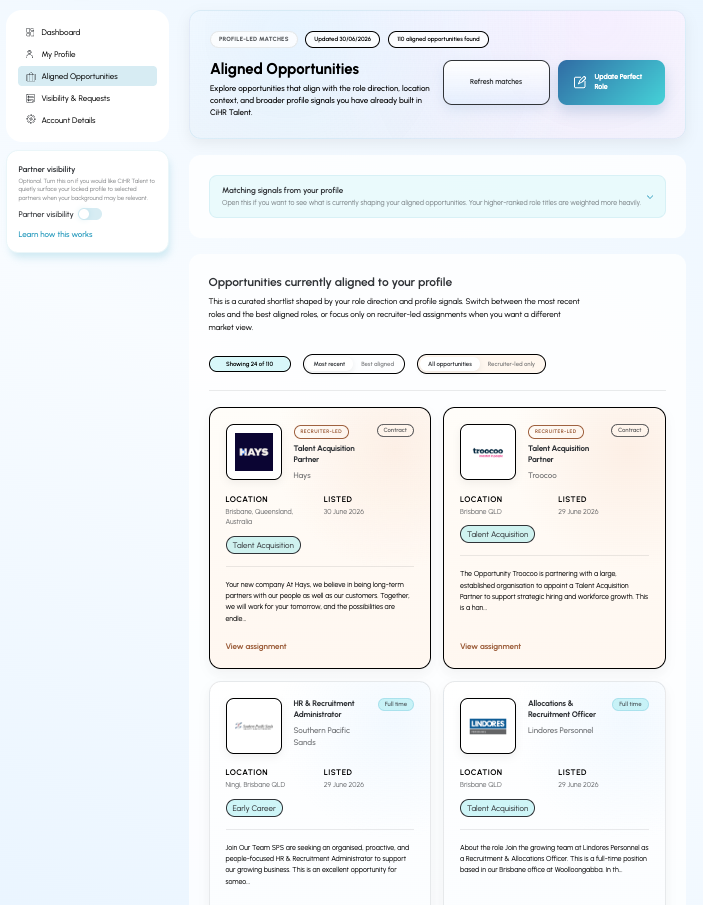
- See aligned opportunities shaped by your role direction, location, and profile signals.
- Move between profile work, opportunity visibility, and account settings from one dashboard.
One question at a time, until you can say it plainly.
A session is a single question worth thinking about, four angles to approach it from, and a place to write. You can do one and stop. Nothing is gated behind finishing everything.
Answer in your own words
The coach asks, reflects back what you have written, and names what is still missing. It will not write your answer for you — an artifact you did not write is no use in a live conversation.
Keep what you can use
Each session produces one thing: a value proposition, a direction, evidence you can reuse, or the conditions a role has to meet. Revisit and sharpen it whenever your thinking moves.
Put it to work
What you wrote reads every opportunity you are shown, shapes your ReadNotes before you apply, and goes into your profile export. If it is not used somewhere, it should not exist.
What this deliberately does not do
It does not write your positioning for you. The coach asks better questions and shows the gaps; the words stay yours.
It does not reorder your opportunities based on what you wrote. Ranking stays predictable, and your reflection adds an honest read on each role instead — including where it is a stretch.
It does not require a finished profile. One session is useful on its own, and you can leave the rest.
Three surfaces in one subscription. One that is free.
Market shows what is live, Read helps you decide what deserves your energy, and Talent is where you work out what you have to say for yourself. Tenure sits alongside them: a private journal for the role you are already in, free to anyone, whether or not you subscribe.
01 / Market
See what is live
Market gives you a clearer view of Australian HR opportunities across employer, recruiter, job board, and public hiring sources.
02 / Read
Decide what deserves your energy
Read lets you shortlist roles and create ReadNotes that compare the source job ad with your application material.
03 / Talent
Position yourself clearly
Talent is where you work out what you have to say for yourself, and turn it into something you can use.
Free · Tenure
Reflect while you are still in the role
A private journal for the job you are in now — what fits, what grates, what you are learning. Free, nothing to pay, and yours to keep. Most people only think about their career once they have decided to leave; Tenure is for the eighteen months before that.
Twenty minutes, and you can say what you are worth.
Begin with your value proposition — what you are trusted with and the value you create. One session, in your own words, and it is yours to use.